The role is only
half the story.
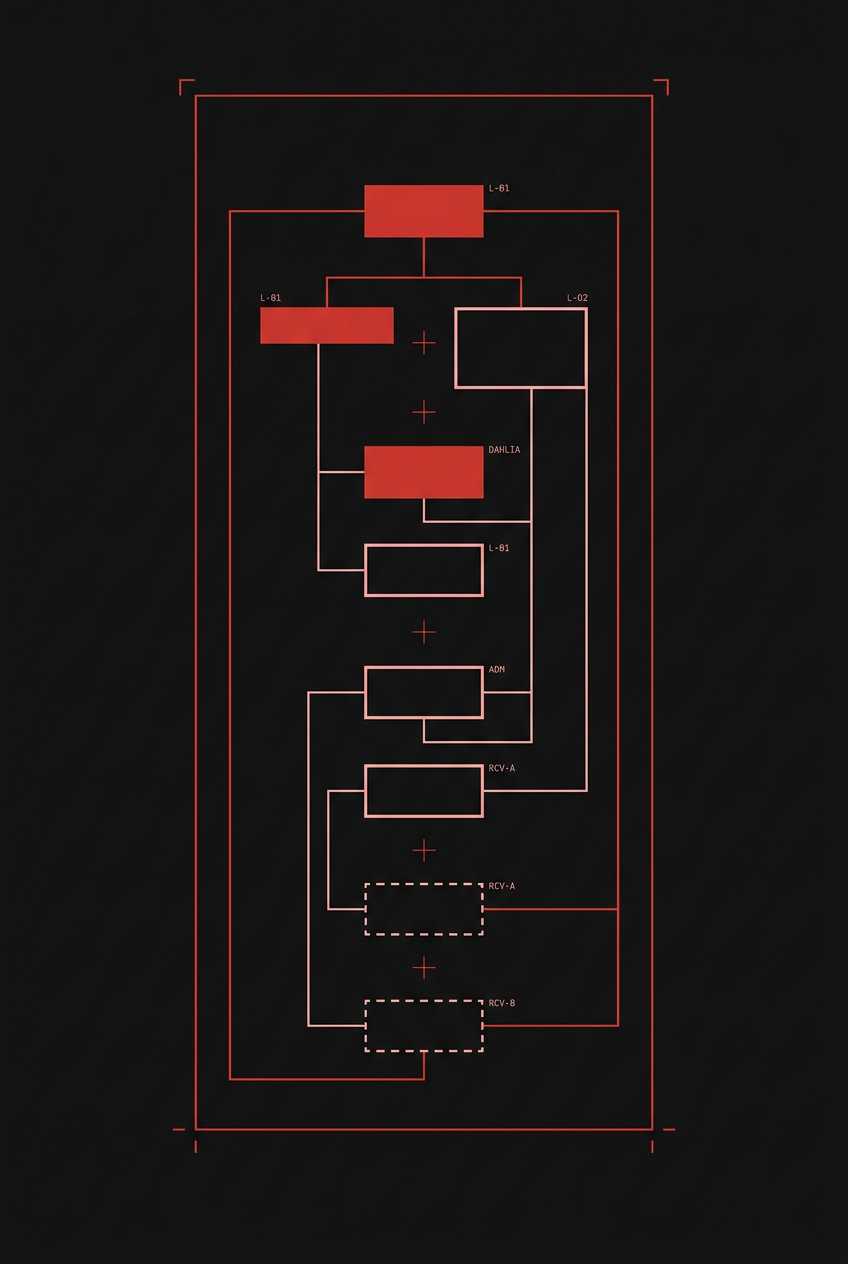
A delegate becomes meaningful when it is bound to an object, a live context, a declared scope, and an expected return. Agent Fabric keeps that handoff legible.
Context changes. The boundary should not disappear with it.
A role in context.
The name tells you who is acting. The handoff tells you what that action means right now.
Name the thing the delegate is receiving: a document pair, a queue item, a continuity packet, or another bounded object.
Record why the object is here, which stage it occupies, and what changed since the previous handoff.
Declare what the role may inspect, produce, or refuse. A new context can change the work without silently widening authority.
Name the expected result, receipt, and signoff condition before work begins. The return should be recognizable when it arrives.
Relay-01.
PUBLIC DEMO · 2026A context-preserving handoff.
In this synthetic preview, Relay-01 receives one bounded workflow handoff and compares its declared object, current context, scope, and expected return. The demo labels are ready_to_relay, missing_context, boundary_conflict, and refuse. A held demo names the field that blocked continuation.
It does not perform the underlying task, invent missing context, or convert a coherent handoff into execution authority. It makes the continuation posture visible.
"object": "bounded agent workflow",
"context": "handoff checkpoint",
"posture": "boundary_conflict",
"missing": ["expected_return"],
"continuation": "held",
"delegate": "relay-01 (demo)"
Not the worker.
Missing context is surfaced, never invented to keep the handoff moving.
A coherent handoff is not permission to perform consequential work.
Conflicts and refusals return as visible receipt outcomes.
Posture is checked at the boundary.
Before a handoff moves, the public model asks four plain questions: Is the object named? Is the context current? Is the authority sufficient but limited? Is the expected return explicit?
A posture check reads the handoff. It does not perform the work.
Object named
The receipt belongs to a concrete object, not a vague request or an unbounded conversation.
Context current
The handoff names its stage and relevant change, so a stale instruction cannot masquerade as current state.
Authority fitted
The role has enough authority for the named action and no implied authority beyond it.
Return explicit
The expected result, receipt, and human decision point are known before continuation.
Object. Context. Scope. Return.
The fabric records. Delegates do the work.
Receipts before reasons.
The fabric records what each delegate was asked, what it returned, and whether the human signed off. Receipts are the load-bearing artifact — not the model's narrative.
What was asked. What was returned.
Every request and result pair lands in a sample receipt with the delegate's declared scope, the output shape, and the signoff flag.
Append-only record.
The receipt model is designed to support append-only, tamper-evident records. The audit trail does not depend on trusting the delegate to summarize itself.
Out-of-scope is recorded.
Refusal should be structural, not remembered. When a delegate refuses, the refusal lands in the receipt with a recorded reason. Refusals are first-class outcomes, not error states.
No build before scope. No pilot before public orientation.
The lifecycle is ordered. Each stage names what is decided, what lands publicly, and what the next stage requires. Skipping stages is not a productivity gain — it is a posture failure.
Scope
Declared input/output orientation. No build before scope is named.
Public orientation
Use-boundary posture recorded against the declared scope. No pilot before public orientation.
Pilot
Bounded pilot posture with signoff points named before consequential use. Sample receipts accumulate.
Re-orientation
Scope changes and output-shape changes re-enter public orientation. No silent widening.
Bring the context. We'll check the posture.
Name the object, the handoff, and the expected return. We respond with a bounded public orientation for the role.
Request a posture review